Mostrando postagens com marcador Asia. Mostrar todas as postagens

domingo, 16 de dezembro de 2012

Top 7 k-pop bands


I believe most everyone has already heard or/and danced Psy’s major youtube hit “Gangnam style”( in case you haven't, don't waste time and watch it NOW: http://www.youtube.com/watch?v=9bZkp7q19f0), however let us not forget that there is a lot more of Korean music where Psy came from! To those who, like me, enjoy listening to new stuff every now and then, I made a list of my 7 favorite Korean bands/ singers and their “best" songs. Make sure to check them below and let me know which is your favorite K-pop band/ song" 

Galera, todo mundo já ouviu o hit do Psy Gangnam style, né? (Se você ainda não viu, assista AGORA por que super vale a pena conferir: http://www.youtube.com/watch?v=9bZkp7q19f0). Além do Psy, várias outras bandas coreanas também tem bombado na internet e por isso eu fiz esse post com as minhas 7 bandas de K-pop favoritas! O que vocês acharam? 


1- SNSD (Girl’s Generation) -The Boys (English version) / Gee  (I'm sorry guys, SNSD is my favorite band, so I can't just pick one song! I had to pick at least the two ones I LOVE the most!!) 


So guys, what did you think of my ranking? Do you have any suggestions?
Então galera, alguma sugestão de alguma banda/ música que deveria entrar para o Top 7?
PS: These is MY top 7, so don't criticise me!


terça-feira, 4 de dezembro de 2012

Aegyo in South Korea


If you watch any Korean dorama (a dorama is a type of soap opera that is very common in the Asian world) or go through some video clips by some famous Korean bands and singers (to name a few examples: Girl’s Generation, B1A4, SISTAR, and Hyuna) you’ll find it impossible to not notice how girls and boys talk and act and how different it is from our western world. At first sight what you will notice is that most girls and women are constantly trying to look childlike and cute and you might even think that they have a mental problem or that they are stuck in their early teens. A friend of mine once even suggested that Korean girls acted “cute” to draw the attention of older men who might find it arousing to fantasize about younger girls.  However, by having a second look at the same video clips and doramas, it should be clear that being “cute” in Korea, or as they say, aegyo, is far more than an isolated incident; in fact, it is a cultural practice that very often takes place in Korea.

Aegyo (Hangeul: 애교) is a Korean adjective that translates into English as “winsome”, which according to the Cambridge dictionary means: “(adj) attractive and pleasing, with simple qualities, sometimes like those a child has”. To put it simply, aegyo is looking cute in a very childlike fashion. However, in terms of society, there is much more than meets the eyes and being aegyo in South Korea takes a whole new dimension.  It is present in music, in their doramas, in people’s everyday life and it has affected Korean society from the way people make music to the types of plastic surgeries that are performed.

First and foremost, we have to consider that aegyo is typically South Korean and that it is usually associated to young females, though some boys are also very fond of looking aegyo, too.  According to the vlog eat your kimchi , women tend to try to look aegyo since they are very young until they are in their mid-thirties,  after that, they no longer try to sound and look cute unless they are making fun of something.  Thus, this practice seems to be related age and also to gender.  

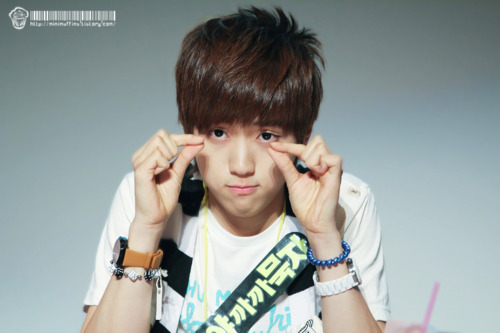
To look aegyo is an activity that involves the whole body as well as the voice. Girls can close their eyes, pout their mouths, and pinch their cheeks, twirl their hair in order to look cute. Boys often make finger horns, duck faces, and finger hearts. To top it off, they can lengthen the duration of the vowels and slightly raise the pitch of their voices to sound childish and needy. The aim of doing all of the aforementioned changes is to captivate people’s attention by looking so cute that people are likely to get a cuteness overload by just having a glance at you.

As mentioned before, this practice nowadays is widely spread , not only on TV but also in real life. As matter of fact, people have gotten so interested in looking younger that there is even a surgery called “aegyo sal surgery” which aims at filling the lower part of your eyes so that they look bigger, therefore, making you look younger and more “aegyo-ish”. This procedure is purely aesthetic and has been criticized for many people do not understand the difference between aegyo sals and eye bags. The difference however is that whereas aegyo sal contributes to your looking good and juvenile, eye bags are saggy and darked, and most often makes you look tired. Not to mention that the only way one can get aegyo sals is by surgery while anyone can get eye bags by not sleeping properly.

In a nutshell, “aegyo” is an important aspect of Korean culture and it needs to be thought of in the light of the fact that Asian culture is somewhat different from our western culture. People need to stop looking at other people’s culture having their mother culture’s perspective. Before judging Korean girls and boys as silly and childish, one needs to understand that beauty standards differ from country to country as well as from time to time. What is considered cute in one culture may be seen as stupid or extremely unattractive in another culture’s perspective.  This said, it is important to understand what “aegyo” is if one wants to attempt to understand how Koreans see beauty and to construe all the underlying meanings of what being cute is for the majority of Korean people.


References:

terça-feira, 6 de novembro de 2012

Maneki Neko: a bit of Japanese culture


"Maneki Neko” is a very common artifact in the Japanese culture and roughly translates into “beckoning cat” or “welcoming cat” because of its lifted paw which is said to be welcoming people. Maneki Nekos are believed to be lucky charms and are usually placed in front of stores and inside houses all across Japan as a means to attract customers and friends.  Apart from being a lucky charm that brings love, money, and peace depending on its color and which paw is being raised, Maneki Nekos are very typical cultural artifacts from Japan and this is the reason why we chose to analyze and study them.

The history of Maneki Neko dates back from the Edo Period (1693- 1867), however, the information found from this period is scarce, which suggests that maneki nekos were not as common then as they are nowadays. Nevetheless, From the Meiji Period (1868- 1912) onwards, maneki neko becomes a very common lucky charm and registers are already plentiful, differently from the Edo Period. A possible explanation for this growth of Maneki Nekos in Japanese culture relies on the fact that in Japan during the Edo Period, brothels used to have a shelf on which the owners of the establishment would keep a large amount of lucky charms shaped as penises.  Keeping that in mind, it was quite hard for the Japanese people not to shock westerners when they visited Japan. So as a means to make Japan a more “decent” country in the light of the Western Christianism, the owners of brothels decided to change the lucky charms that were molded as penises to those of cats, since cats symbolize woman in the Japanese imagery.

On top of that, there are many myths and legends on the origin on Maneki Neko. One of the most famous legends has it that in a village there was a geisha who had a small cat whom she loved very much. One day, however, her cat started to tug at her apparently without any reason. Seeing this, a brave swordsman thought that the cat was attacking the geisha and as soon as he could, he chopped off the head of the cat, which flew to the ceiling, killing a poisonous snake that was about to strike. Needless to say, killing the cat made the geisha very sad; this touched the swordsman very deeply to the point that he asked a very skilled craftsman to carve a likeness of the murdered cat, thus making the geisha happy again.

The second story is about a noble man who was coming back from a hunt and was caught on in a very violent storm. In the midst of the downpour, the man saw a cat beckoning to him as if it were calling him. Following the cat, the man was startled by the fact that as soon as he got away from where he was, a lightening hit a tree which fell down just where he was. The cat had saved his life as a token of his appreciation he started to make carved copies of the magical cat as an homage.

In conclusion, Maneki Nekos are very cute little catlike charms which are said to have the power to bring luck, money and heath depending on their color and on which paw it is raising. They are ancient cultural artifacts and reflect a very nice aspect (perspective) of Japanese culture: their supersticiousness. So, if you ever happen to visit Japan, make sure to buy yourself some maneki nekos, you never know when you may need some extra luck.
 ps: The Pokemon Meowth is based on the Maneki Neko! 

Tags 3

Pages - Menu

Tags 4

Popular posts

Seguidores

About Me

Minha foto
Just an ESL teacher who might make some difference in this world... A world that is already plagued with indiference, prejudice and all sorts of bad things... Anyway, I hope you enjoy this blog and what it's got to offer.

Blogger templates

Tags 2

Tags 1